Safety Note
This article covers at-home paw hair trimming using purpose-built electric trimmers. It does not cover nail trimming, which has separate safety considerations and risks (including cutting the quick). If your dog has matted paws, skin irritation, excessive licking, or signs of infection between the toes, see your vet before attempting any home grooming. We may earn commissions from affiliate links in this article.
Trimming the hair around your dog’s paws is one of the most overlooked parts of home grooming — and one of the most important. Overgrown paw hair causes slipping on hard floors, painful matting between the toes, and a dirt trap for everything your dog walks through. The good news is that with the right trimmer and a calm approach, it takes under ten minutes per dog.
The tricky part is choosing the right tool. Most general-purpose pet clippers are too wide and too noisy for sensitive paw areas, especially with anxious dogs. This guide covers the genuine choices available in the UK and how to use them safely.
Why Paw Hair Needs Regular Trimming
Dog paw pads need direct contact with the ground for grip. When hair grows out past the pads, it effectively turns them into furry slippers. On tiled floors, laminate, or wet outdoor surfaces, this causes visible slipping — which puts stress on joints, especially in older dogs or dogs already managing hip or elbow issues.
Beyond traction, long paw hair is a debris collector. In winter, ice and grit can form painful balls between the toes. In summer, grass seeds, burrs, and allergens mat in and can cause skin irritation that leads to obsessive licking. The British climate makes this worse — wet walks are weekly, and moisture accelerates matting in fluffy coats.
The goal is not to remove all paw hair. The hair nestled between the pads provides insulation and cushioning but the overgrowth that extends past the pad surface is what causes problems. Trim to pad level, not below it.
The PDSA’s dog grooming guidance notes that long fur between toes is a common comfort issue that owners can manage at home with appropriate tools.[1]
What happens if you skip it
| Problem | Cause | When it becomes serious |
|---|---|---|
| Slipping on smooth floors | Hair covers paw pads, removing grip | Immediately — injury risk on tiles, stairs |
| Matting between toes | Friction, moisture, and debris bind hair | Within weeks — mats pull skin and cause sores |
| Debris buildup | Long hair traps grit, salt, allergens | Year-round, worse in winter and summer |
| Obsessive licking | Dog tries to remove irritant stuck in hair | Usually signals matting or embedded debris |
| Overheating | Dense hair reduces paw-pad cooling efficiency | Warm months — dogs regulate heat partly via paw pads[2] |
What to Look for in a Dog Paw Trimmer
Paw trimming requires a different tool from full-body grooming clippers. The blade needs to be narrow enough to get into the space between toes without catching skin. The motor needs to be quiet enough that anxious dogs will tolerate it close to their face and feet.
Essential features checklist
| Feature | Why it matters | What to look for |
|---|---|---|
| Quiet motor | Anxious dogs won’t tolerate vibration near paws | Under 50dB — described as “whisper quiet” in specs |
| Narrow blade | Safe access between toes without nicking skin | Blade width under 30mm for paw use |
| Cordless operation | Manoeuvring around a dog needs freedom of movement | USB rechargeable, 2+ hour battery |
| Lightweight | Long sessions on a squirming dog need a comfortable grip | Under 200g |
| Washable or easy-clean | Hair buildup slows blades — cleaning matters | Detachable blade or rinse-friendly design |
Why scissors are not an alternative
The skin between dog toes is thin, webbed, and sits directly under the hair. Even blunt-nosed scissors create real risk of catching that skin when a dog moves suddenly. Professional groomers who use scissors in this area use specialist blunt-tipped grooming scissors and years of practice. For home use, a purpose-built electric trimmer is the correct tool.[3]
Best Dog Paw Trimmers in the UK
Three trimmers cover the full range of UK buyers — from first-time owners with nervous dogs to professional groomers handling multiple dogs daily.
Which dog paw trimmer is best in the UK?
The Casfuy Dog Paw Trimmer is the best choice for most UK pet owners, combining an ultra-quiet under-50dB motor, a narrow ceramic blade designed specifically for paw areas, and a rechargeable battery that handles multiple sessions. For professional or multi-dog use, the Wahl ARCO has no equal for durability and performance.
Casfuy Dog Paw Trimmer — Best for anxious dogs and first-time owners
The Casfuy is purpose-built for paw trimming. Its narrow head and low-vibration ceramic blade are specifically designed for the sensitive area around toes and pads — not a scaled-down body clipper pressed into service as one. The under-50dB motor is notably quiet, which is significant: many dogs who refuse body grooming will accept paw trimming with the Casfuy because the sound and vibration are minimal.
- Motor noise: Under 50dB — measurably quieter than most standard clippers
- Battery: USB rechargeable, 3+ hour runtime — enough for a full session on multiple dogs
- Blade: Narrow ceramic blade, detachable for cleaning
- Weight: Around 150g — easy single-hand control
The limitation is that it is designed purely for detail work. It will not handle severely matted paw hair, which needs to be detangled or cut out first by a professional.
Casfuy Dog Paw Trimmer
Ultra-quiet ceramic blade trimmer designed for sensitive paw and face areas
oneisall 2-in-1 Dog Clippers and Paw Trimmer — Best value for versatility
The oneisall handles both full-body clipping and detailed paw work via two interchangeable blade attachments. It is an IPX7-rated waterproof design — practically relevant in the UK, where you can rinse the blade under running water for cleaning rather than blowing hair out with a brush.
- Battery: 2.5-hour runtime with USB-C charging
- Blade system: Dual function — wide blade for body, narrow blade for paw/face detail
- Waterproofing: IPX7 rated — washable under running water
- Guide combs: Four included (3mm, 6mm, 9mm, 12mm)
It is slightly heavier and louder than the Casfuy, so it is less suitable for very anxious dogs. For calm dogs or owners who want one device for both full-body grooming and paw detail, it offers genuine dual-purpose value.
oneisall 2-in-1 Dog Clippers
IPX7 waterproof dual-function trimmer for full-body and paw detail work
Wahl Professional Animal ARCO — Best for professional and multi-dog use
The Wahl ARCO is professional grooming equipment. It is what working groomers across the UK actually use for paw and face detail work, and the reason is straightforward: the blade system is interchangeable with the full Wahl professional blade range, the motor is designed for sustained daily use, and the 5-hour battery does not die mid-session.
- Motor: Rotary motor designed for continuous professional use
- Battery: 5+ hour runtime with fast charge
- Blade compatibility: Standard Wahl snap-on blade system (#30, #40, #50 compatible)
- Build: Designed for daily professional use over years, not months
- Warranty: 3-year professional warranty
The trade-off is cost — it is significantly more expensive than the other options, and the interchangeable blade system adds ongoing cost. For a household with one or two dogs, this is overkill. For professional groomers or households with three or more dogs groomed regularly, it is the correct tool.
Wahl Professional Animal ARCO
Professional-grade cordless clipper with interchangeable blade system and 5-hour battery
Quick comparison: paw trimmers for UK buyers
| Trimmer | Motor noise | Battery | Best for | Price range |
|---|---|---|---|---|
| Casfuy | Under 50dB (ultra-quiet) | 3+ hours | Anxious dogs, first-time owners | Budget–Mid |
| oneisall 2-in-1 | Low (slightly louder) | 2.5 hours | Versatile home grooming | Budget–Mid |
| Wahl ARCO | Moderate | 5+ hours | Professional / high-frequency use | Premium |
How Often Should You Trim Dog Paw Hair?
The practical answer is: check every two weeks and trim when the hair extends past the pad surface.
Breed type determines the actual frequency:
| Breed type | Hair growth rate | Recommended check frequency | Trim frequency |
|---|---|---|---|
| Poodles, Doodles, Spaniels, Shih Tzus | Fast, continuous | Weekly | Every 2 weeks |
| Golden Retrievers, Labradors | Moderate | Every 2 weeks | Every 3–4 weeks |
| Border Collies, Bernese Mountain Dogs | Moderate | Every 2 weeks | Every 4 weeks |
| German Shepherds, Rottweilers, Dobermans | Slow | Monthly | Every 6–8 weeks (or as needed) |
| Short-coated dogs (Beagles, Boxers) | Very slow | Monthly | Rarely, if ever |
The reliable test: Flip the paw over. If hair is visibly extending past the pad surface, it is time. If the pads are clearly visible and the hair sits level with them, it is not.
Making a quick paw check part of your weekly walk-return routine takes around 30 seconds per dog and tells you exactly when trimming is needed.
How to Trim Dog Paws at Home: Step-by-Step
This method is appropriate for dogs who are comfortable with handling. For dogs with a history of aggression during grooming, or severely matted paws, book a professional first — the first session is better spent with someone trained in safe restraint techniques.
Before you start
Gather everything before approaching your dog:
- Charged paw trimmer
- High-value small treats
- Good lighting — ideally natural or a bright lamp on the area
- A non-slip mat if you are working on a hard floor
Step 1 — Introduce the trimmer off (then on)
Let your dog sniff the trimmer while it is off. Give a treat. Turn it on, hold it away from the dog so they just hear it. Give a treat when they stay calm. This can take 2–3 minutes at the start and becomes unnecessary after the first few sessions.
Step 2 — Work on one paw at a time
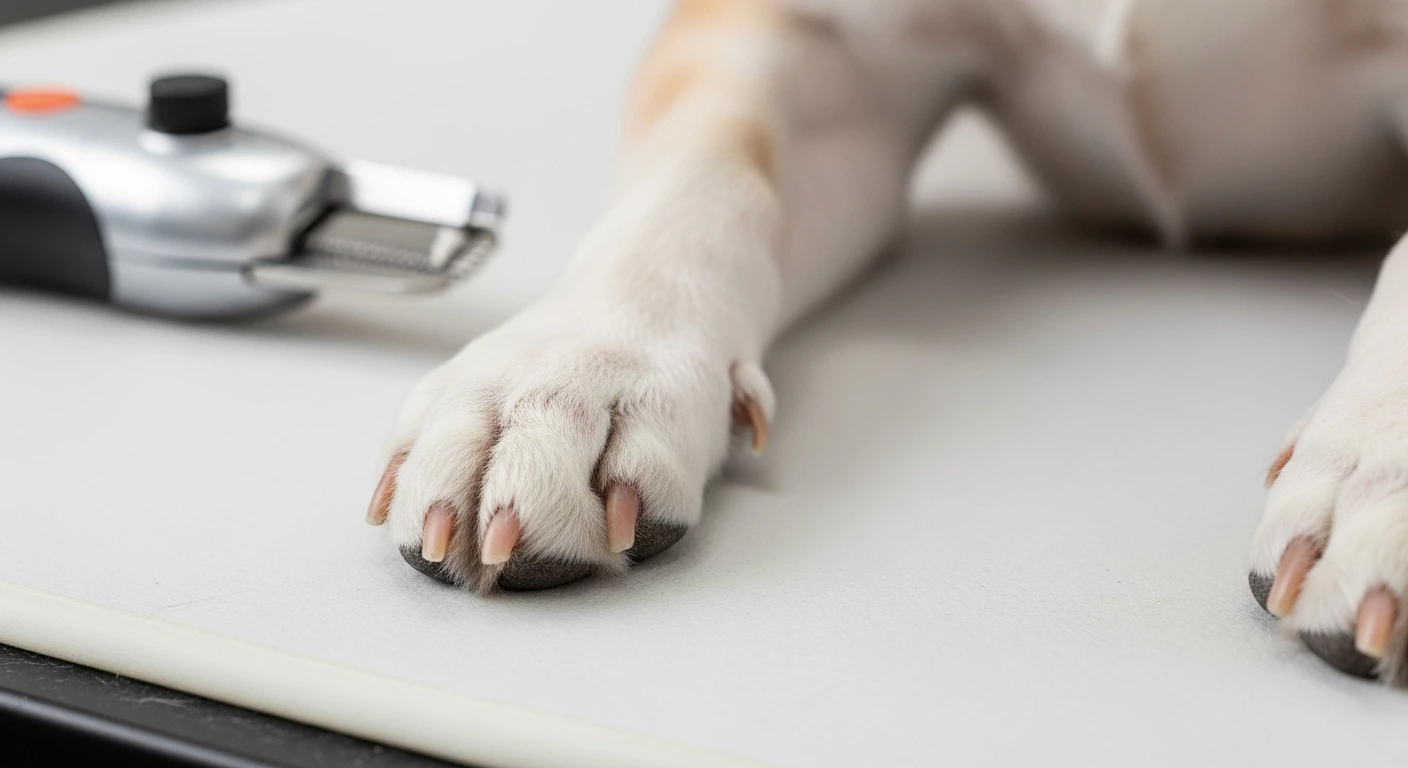
Have the dog lying on their side. Hold one fore paw firmly but without squeezing. Use your fingers to gently spread the toes — this exposes the hair and gives you a clear view of the pad line.
Step 3 — Trim to pad level, moving away from the pad
Using a flat sweeping motion, trim from the pad surface outward. The goal is to get the overgrowth level with the pads, not to dig in or trim below pad level.[4]
Trim around the outside edge of the paw to remove excess hair fringing the sides. Do not probe between the toes themselves — this area is too sensitive for home trimming.
Step 4 — Stop early rather than push through
For the first few sessions, completing one or two paws is a success. End the session while the dog is still calm — before they become stressed. Finish with a high-value treat and positive interaction.
A calm 5-minute session that trims two paws beats a 15-minute battle that teaches the dog grooming is frightening. You can do the remaining paws the next day.
Step 5 — Wipe and check
Wipe the paw with a damp cloth to remove stray hair clippings (these can tickle and cause the dog to lick). Check the pad surface is visible and level. Apply paw balm if the pads look dry or cracked.
When to use a professional groomer
Not every dog cooperates with home paw trimming — and for anxious, reactive, or large dogs, a professional groomer with a proper table and trained handling technique will get a safer result faster. Severely matted paw hair also needs professional de-matting before trimming is safe.
Find local groomers who take bookings for nail and paw trims: Folkestone groomers · Dover groomers · Hythe groomers · Sandgate groomers. For grooming costs across Kent, see our dog grooming prices guide.
Can Trimming Paw Hair Stop Excessive Licking?
Sometimes, yes — if the licking is caused by irritation from trapped debris or small mats. A dog licking between their toes consistently is often trying to remove something that is bothering them. Trimming removes the hair that was trapping the irritant, and the licking stops.
However, if trimming does not resolve it, the cause is likely separate:
- Allergies: Environmental or food allergies frequently manifest as itchy paws
- Fungal or bacterial infection: Warm, moist hair between toes is a common site for yeast infections — signs include redness, smell, and discolouration of the hair
- Anxiety or boredom: Some dogs lick as a self-soothing behaviour, not because of a physical irritant
- Embedded debris: Small thorns or grass seeds can burrow in and cause persistent licking
If the licking continues after trimming, or if you notice redness, swelling, an unusual smell, or skin discolouration between the toes, see your vet. Paw licking that continues for more than a week despite clean, trimmed paws warrants investigation.[5]
Paw Pad Care: Beyond Trimming
Trimmed hair is the main task, but paw pads themselves can also become dry and cracked — particularly in cold winters and hot summers. Dry pads are uncomfortable and more prone to splitting.
Natural moisturising with coconut oil is safe and effective for most dogs. Apply a small amount (pea-sized per paw) and rub it gently into the pad. It is safe if licked in small quantities and absorbs well. Use it after walks rather than before, so the dog is not going directly onto wet outdoor surfaces.
Avoid human hand creams and lotions — many contain zinc oxide, macadamia oil, or fragrance compounds that are toxic to dogs if ingested.[6] Purpose-formulated dog paw balms (widely available at Pets at Home and online) are a safer commercial option.
Routine after walks:
- Wipe paws with a damp cloth to remove road salt, chemicals, or allergens
- Dry between toes — leaving moisture trapped in hairy paws is how minor irritation becomes a yeast infection
- Check for cuts, swelling, or any embedded debris while you are already handling the paw
This adds around two minutes to a post-walk routine and catches most minor paw issues before they become vet appointments.
The Bottom Line
For most UK dog owners, the Casfuy is the right paw trimmer. It is made for this specific task, quiet enough for anxious dogs, and priced reasonably. If you want one device that handles full-body clipping and paw detail, the oneisall 2-in-1’s waterproof design and dual blade system make it the logical choice. The Wahl ARCO is the correct answer only if you are grooming multiple dogs frequently or working professionally.
Whatever trimmer you use, the technique matters more than the tool. Short sessions, high-value treats, and stopping before the dog becomes stressed will build a dog that accepts paw handling easily — which matters beyond just trimming, for vet checks, nail clips, and injury inspection throughout their life.
For a complete picture of how often different grooming tasks need doing and by whom, see our complete dog grooming frequency guide.
Frequently Asked Questions
What is the best dog paw trimmer in the UK?
The Casfuy Dog Paw Trimmer is the best choice for most UK home users, primarily because of its under-50dB motor — quiet enough for anxious dogs who would not tolerate standard clippers near their paws. For professional or high-frequency use, the Wahl ARCO has a more durable motor, interchangeable blade system, and 5-hour battery life.
How often should I trim my dog’s paw hair?
Check every two weeks and trim when hair extends past the pad surface. High-maintenance breeds (Poodles, Doodles, Cocker Spaniels) typically need trimming every two weeks. Short-haired breeds (Beagles, Boxers) may rarely need trimming at all. Outdoor dogs in wet climates need more frequent checks because moisture accelerates matting.
Can I use scissors to trim my dog’s paw hair?
No. The skin between dog toes is thin, webbed, and directly adjacent to the hair. Scissors create a real risk of catching this skin, especially when the dog moves unexpectedly. A purpose-built electric paw trimmer with a narrow blade is both safer and easier. Professional groomers who use scissors in this area do so with specialist blunt-tipped grooming scissors under salon conditions — not at home.
Do I need to trim between my dog’s toes?
Trim the hair that extends past the pad surface, but do not probe into the webbing between the toes. The overgrowth extending below and around the pad is what causes slipping and debris buildup. The hair within the toe webbing itself is best left to a professional groomer if it needs attention — the risk of nicking the skin in that area at home is too high.
Why is my dog licking their paws so much?
The most common causes are matted or overgrown paw hair trapping debris, small foreign objects like grass seeds embedded between toes, salt or chemical irritation from roads in winter, skin allergies, or fungal infection between the toes. Trimming the hair is the right first step — if the licking continues after trimming, see your vet. Persistent paw licking with redness, swelling, or smell between the toes is typically an infection requiring treatment.
Should dog paw pads be moisturised?
Yes, particularly in cold dry winters and hot summers when pads are more prone to cracking. Coconut oil (pea-sized amount massaged into each pad) is safe and effective. Avoid human lotions and creams — many contain ingredients that are toxic to dogs if licked. Purpose-formulated dog paw balms are also widely available. Apply after walks rather than before, so the dog is not walking on slippery moisturised pads.
How do I trim a dog’s paws if they won’t stay still?
Start with the trimmer off, let the dog sniff it, reward with high-value treats. Turn it on with it held away from the dog so they hear the hum without vibration on their body, reward calm behaviour. Progress to touching the non-blade side to their back, leg, then paw over several short sessions before attempting any trimming. If the dog remains too anxious after several sessions of this, book a professional groomer who uses proper grooming tables and trained restraint techniques — this is not a failure, it is the right call for the dog’s welfare.
What do paw trimmers cost in the UK?
Budget to mid-range paw trimmers (Casfuy, oneisall) typically cost £15–£40 on Amazon UK. Professional-grade clippers like the Wahl ARCO cost £80–£120. Professional grooming for paw trimming at a salon costs approximately £10–£20 as an add-on to a full groom, or can be included in a standard groom depending on the groomer. For Kent grooming prices, see our dog grooming prices guide.
References
- PDSA — Dog Grooming Guide: How to Keep Your Dog’s Coat and Paws Healthy
- Blue Cross — How Dogs Regulate Their Body Temperature
- AKC — Paw Trimming: Should You Trim the Hair on Your Dog’s Paws?
- Battersea — Grooming Your Dog at Home
- PDSA — Why Is My Dog Licking Their Paws?
- PDSA — Foods and Household Products That Are Dangerous to Dogs
Move from research into real local options
Use the directory to compare live grooming listings, or check the Kent price guide first if you want a quick cost sense-check before contacting a business.